Global Data Signals CEOs Must Respond to a New Leadership Communications Imperative
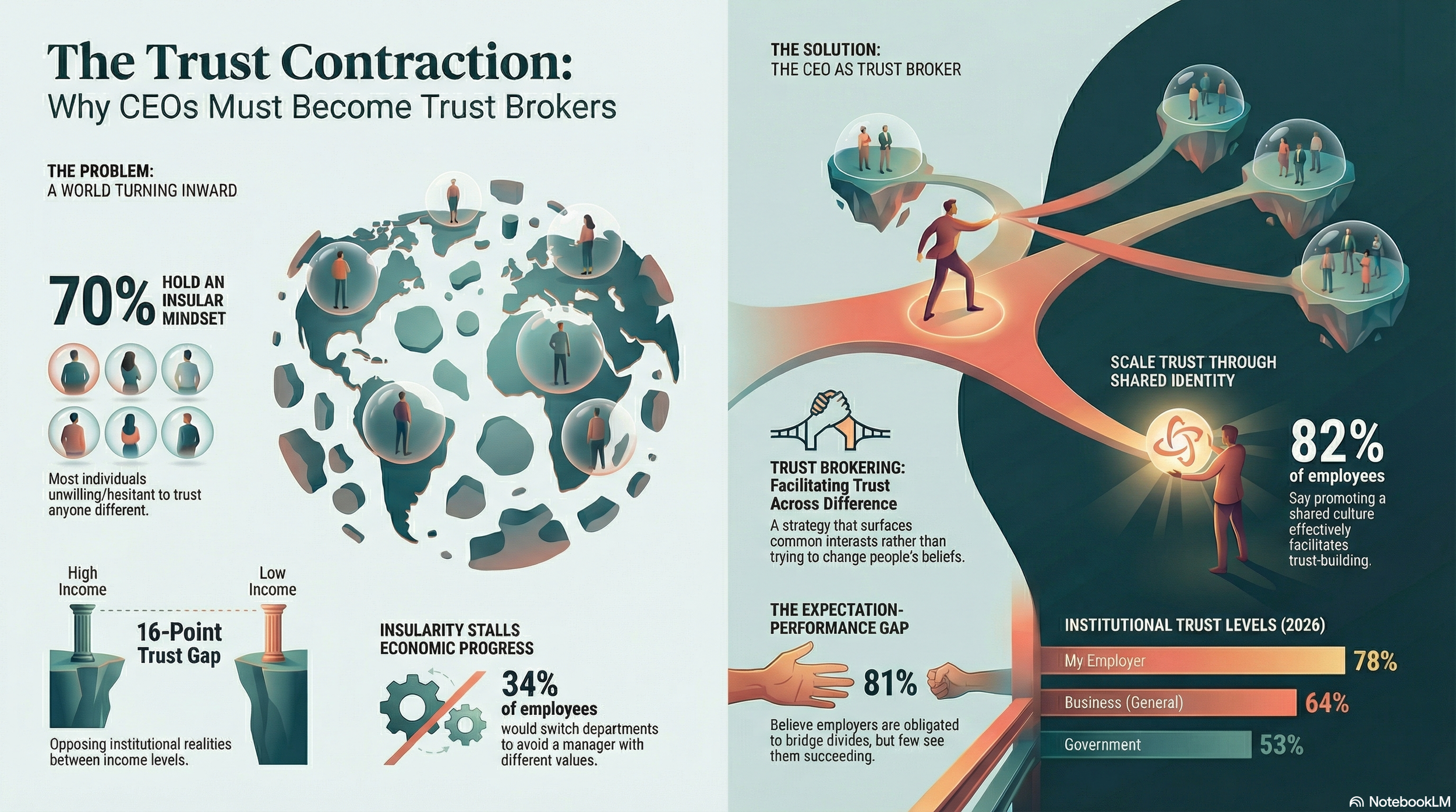
Industry research released at Davos alerts companies that CEO branding and internal communications must be strategic priorities in 2026.
Across the globe, corporate leadership is operating under unprecedented strain. Economic instability, AI-driven technology disruption, workforce anxiety, and increased public scrutiny are all converging at once. As company boards press for resilience, investors demand structured execution and employees call for more transparency.
In this new business environment, positional authority is no longer sufficient.
Recent global research released at the World Economic Forum makes this reality unmistakably obvious to boardrooms. The 2026 Edelman Trust Barometer finds that 70% of its respondents globally report an “insular” trust mindset. People today are more hesitant or unwilling to trust those who differ from them as exposure to differing viewpoints continues to decline. Additionally, only 32% believe the next generation will be better off than the current one.
Trust is not collapsing. It is contracting.
As confidence in broad institutions weakens, the research finds that trust consolidates in closer circles, such as coworkers, local networks, and leaders most immediate to them. Notably, the Edelman research shows net gains in trust toward “my CEO” and “my coworkers,” even as national leaders and media institutions continue to lose ground. Employers remain among the most trusted institutions globally. All of these findings prove that expectations placed on CEOs are greater than ever.
In an environment where trust functions as currency, the CEO becomes one of the last scalable sources of institutional credibility for an organization. Executive visibility is no longer optional, and the internal communication function is no longer administrative. Both are leadership infrastructure.
The Trust Barometer also highlights a consequential expectation gap: large majorities believe CEOs are obligated to help bridge divides. However, even fewer respondents believe CEOs are currently doing this effectively.
This gap represents strategic exposure. When leadership communication is inconsistent, reactive, or absent, trust fragments. In contrast, when it is intentional, structured, and sustained, trust stabilizes and becomes an organizational asset.
CEO branding and executive communications must therefore be treated as board-level priorities.
Employees today do not simply evaluate quarterly performance. They evaluate clarity from the leaders closest to them. They assess whether their leaders explain trade-offs, how they acknowledge disruption, and whether leadership shows intentionality when it engages with its stakeholders.
When people feel the consequences of economic downturns, workplace restructuring, organizational adoption of AI tools, and other workplace changes without disciplined internal communication, trust suffers even more. But the bonds of trust can be strengthened when leaders communicate consistently to employees, reinforce a shared purpose in messaging, and engage transparently even during times of uncertainty.
In the past, the variable of trust has been treated as a sentiment metric on annual employee surveys. Today, it is a performance variable. It shapes alignment, collaboration, and the organization’s capacity to execute strategy under pressure.
Organizations that reserve CEO communication for episodic moments, such as earnings calls or major holiday messages, will struggle in this new era. Organizations that embed regular trust-building activities into ongoing executive presence and structured internal messaging will outperform their competitors.
The takeaway from Davos is clear: trust has moved closer to home.
In a contracting trust economy, the value of leadership communications now extend beyond reputation management. CEOs who treat executive communication as a strategic discipline will see measurable gains in alignment, speed of execution, and overall organizational output. Those who are slow to catch on will find that any net loss in trust is far harder to rebuild than it is to maintain.
This CEO commentary was written by Robert Krueger, executive director at The Communications Board.