The Internet’s Double Standard on CEO Authenticity

Photo by Andrii Kordis / Unsplash
When McDonald’s CEO, Chris Kempczinski, posted a short video of himself eating the brand’s new Big Arch burger, the internet’s snowball response was exactly as it tends to: quick to react with hot takes that echo one another.
The commentary came in waves. First from social media users eager to share their “sick burns,” then from professionals in the communications sector who offered their critiques. The consensus? The video was “awkward,” “overly corporate,” “lacked executive self-awareness,” and a case study in what not to do with your organization’s leaders.
But that consensus misses the point entirely.
In fact, the positive market response to Kempczinski’s initial video showed that the internet is not well versed in leadership communications and CEO branding.
This Wasn’t Inauthentic. It Was Consistent
The dominant critique floating around social media and news articles assumes something fundamentally incorrect: that Kempczinski was putting on an act and failed in the process. He was trying to be performative, and portray a version of himself that does not exist.
This take is incorrect. His video was not posturing.
Kempczinski has been building a social media presence even before he took over as CEO in 2019. In fact, his tone, cadence, and personal demeanor in the video are not anomalies. Instead, they are consistent with how he has shown up across digital platforms. This was not a case of a CEO jumping on a trend. It was a company executive who had been practicing CEO communications for a long time, simply continuing a pattern and staying true to his brand.
In executive communications, consistency is not a flaw. It is the strategy.
We witnessed too many critiques of the CEO’s video post confuse individual charisma with authenticity. These two are not the same. Given the range of leaders across sectors, we know that not every CEO is going to always present like a rehearsed keynote speaker or a media-trained spokesperson. The goal is not performance. The goal is for the company leader to be recognizable and trustworthy.
Kempczinski achieved both.
The Irony of “Authenticity” Culture
There is a deeper contradiction at play with the analysis of Kempczinski.
The same digital voices that routinely criticize social media content that is “overproduced,” “over-rehearsed,” or “corporate” were quick to mock a leader who was, in fact, being himself. The subtext of the criticism – ranging from his delivery, his phrasing, even the way he took a bite – all suggests there is a “correct” way to appear on camera.
There is not.
Executive media training, when done properly, does not aim to standardize personality. It does not seek to make CEOs walk and talk in the same way. Instead, this training helps leaders refine the clarity of their messages. It should never turn every executive into the same polished archetype.
If anything, the online reaction to this video reinforces a damaging norm: that authenticity is only acceptable when it fits a narrow definition that received the approval of a few influential social media users.
That is not authenticity. It is conformity. And in CEO branding, we want our leaders to stand out and be unique.
Where Communications Commentary Went Off Track
More concerning than the social media memes was the professional commentary.
PR and messaging critics positioned the video as a failure of executive communications or CEO branding. That reveals a misunderstanding within the communications industry.
Executive visibility is not judged on a single, standalone post. It is evaluated over time through the marathon of repetition, familiarity, and relationship-building with the audiences that mean the most to your brand. Kempczinski has been doing exactly that.
CEO branding is not about producing viral content. Those who have worked closely with executives understand that it is about establishing a durable, credible presence that your stakeholders both recognize and trust. That voice and presence should be consistent across all communications moments, such as earnings calls, media interviews, and internal communications. And, yes, this even includes the casual product video.
From that perspective, Kempczinski's video was not off-brand. It was perfectly on-brand.
The Outcome Matters More Than the Optics
The most overlooked aspect of this entire episode is the outcome.
Despite the online ridicule, the social media video generated significant product awareness and measurable business value. Kempczinski already had 7 times more social media followers than Starbucks’ CEO, and he gained 30 percent more Instagram followers in the days following the visibility he received from his video.
Additionally, PR and advertising experts estimate that the free media and online conversation around Kempczinski’s video contributed at least $18 million in brand value, while also driving increased sales and social engagement. Mentions surged into the tens of thousands, with billions of impressions across social media platforms.
In other words: the video worked.
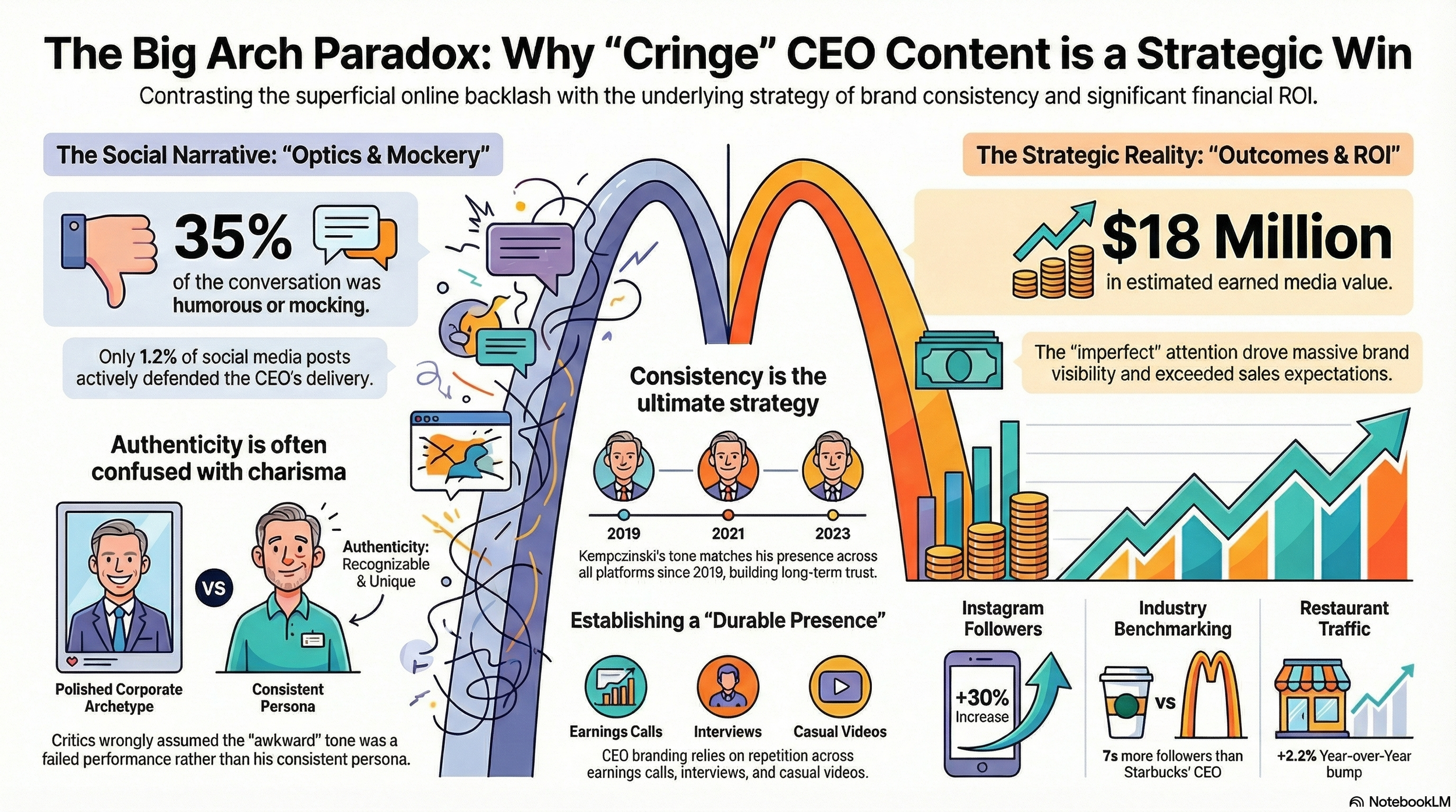
Even competitors joined the conversation, attempting to newsjack the moment with their own cheeky videos. Rather than shifting the conversation, their participation amplified the Big Arch product conversation even further. What began as mild ridicule evolved into a full-scale cultural moment. McDonald’s PR and marketing divisions were likely encouraged in how the moment extended the reach of their newly launched product far beyond what a traditional campaign might have achieved. The Wall Street Journal reported despite the online critiques of the video, there was a lot of attention for the Big Arch burger and sales were already exceeding expectations.
This is a fundamental principle in modern communications: attention, even when imperfect, can be an asset if it is aligned with brand visibility and positive business outcomes.
The Real Risk Is Overcorrecting
This case highlights a broader gap: while communications professionals may understand executive branding in theory, many still underestimate how it functions in practice. Additionally, for those advocacy professionals who grew up in the social media era and are fluent in personal branding language, it appears that most are still not familiar with the strategy, value, and business objectives behind leadership communication and CEO branding.
This moment risks deterring the next generation of leaders, who might hesitate to engage in regular CEO communications. Instead, they might retreat to more overproduced, scripted, and less frequent executive communications efforts.
If our executives become more sensitive to online criticism rather than building presence, they will likely disappear from the very channels where their visibility matters most.
This CEO commentary was written by Robert Krueger, executive director at The Communications Board.